

The Difference Between Asking for Help and Begging: A Reflection on Dignity, Desperation, and the Courage to Reach Out.
Letters from Awriterstip – Week 46

The Difference Between Asking for Help and Begging: A Reflection on Dignity, Desperation, and the Courage to Reach Out
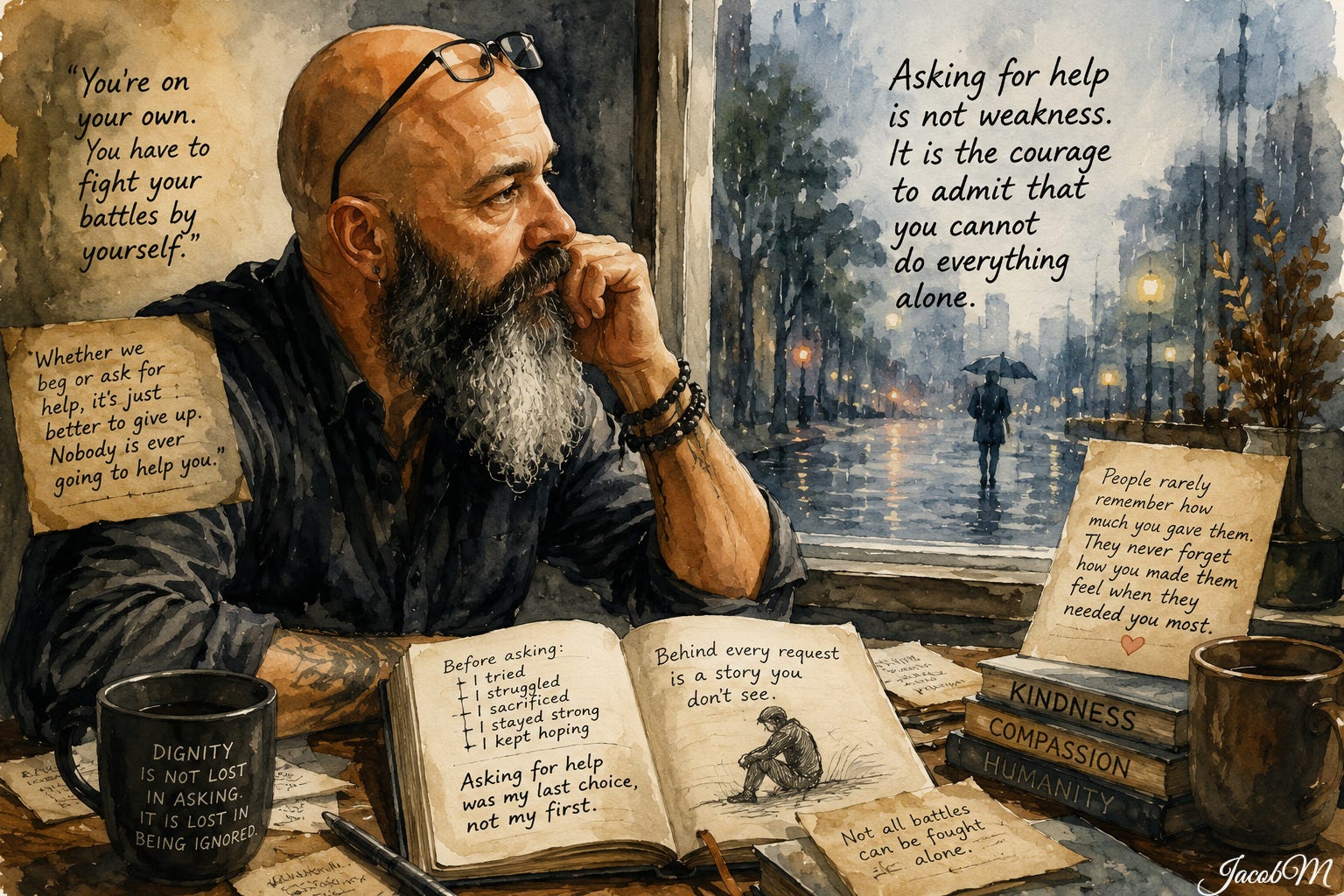
Before You Begin...
Some stories cannot be told in a few paragraphs. They ask for patience because they are built from years of lived experience. This is one of those stories.
Take your time with it.
And if reading isn’t your preferred way to experience it, this essay will soon be available as a podcast episode, where these words can be heard exactly as they were meant to be shared.
There are certain moments in life that quietly change the way we see ourselves. They do not arrive with celebration or applause. They come in silence, often behind closed doors, when the weight of circumstances becomes too heavy to carry alone. It may be the loss of a job, an unexpected illness, financial hardship, loneliness, grief, or simply the exhaustion of trying to survive while pretending everything is still under control. Eventually, there comes a moment when a person looks at their own reflection and realises that they cannot continue without someone else’s help.
That realisation is perhaps one of the most difficult admissions a human being can make.
For most of our lives, we are taught to be independent. We are encouraged to work hard, solve our own problems, stand on our own feet, and never become a burden to others. We celebrate those who rise without assistance and admire stories of people who overcome adversity entirely through their own determination. Independence becomes a measure of success, while dependence is quietly associated with weakness. It is no surprise, then, that asking for help often feels like surrendering a part of ourselves.
I have often wondered where society draws the line between asking for help and begging. On paper, they appear to be different. One is considered acceptable, while the other is often looked upon with discomfort or even contempt. Yet when life places you in a position where you genuinely need another person’s kindness, those definitions begin to blur. The emotions become almost identical. Whether you say, “Could you please help me?” or whether you stretch out your hand hoping that someone will notice your need, the vulnerability feels remarkably the same.
The greatest difference may not exist in the words at all. It exists in the way people choose to see you.
No one wakes up one morning with the dream of needing help. It is rarely the first option anyone considers. Before someone reaches out, they have usually spent countless hours trying to solve the problem themselves. They have searched for work, borrowed against their own resources, sold possessions, sacrificed comforts, delayed payments, skipped meals, hidden their struggles behind polite smiles, and convinced themselves that tomorrow will somehow be different. Asking for help is often the last bridge they cross, not the first.
Unfortunately, the world rarely sees the journey that led to that moment.
No one asks how long you struggled before reaching that point. No one asks how many nights you lay awake trying to find another solution. They only witness the moment your pride finally gives way to necessity.
That is perhaps one of the saddest realities of modern society. We have become experts at evaluating circumstances we know nothing about. We assume laziness where there may be illness. We assume irresponsibility where there may have been tragedy. We assume manipulation where there may simply be desperation. We forget that every person carries chapters of their life that remain invisible to everyone else.
Life has a way of humbling even the strongest among us.
A successful business can collapse because of one unexpected crisis. A healthy person can become dependent after one accident. A stable family can be shattered by divorce or loss. A lifelong career can disappear because of circumstances beyond anyone’s control. We like to believe that hardship only happens to others because that belief allows us to feel safe. The truth is far less comforting. None of us are immune to misfortune. The distance between security and struggle is often much shorter than we imagine.
Perhaps that is why I struggle with the distinction between asking for help and begging.
Emotionally, they both require the same sacrifice.
They require humility. They require swallowing pride.
They require accepting that, at least for this moment, you cannot do everything alone.
People often say, “If you ever need anything, just ask.”
It is one of the most generous sentences spoken in everyday conversation. Yet those words are surprisingly difficult to believe once you actually need them.
The first message is hard to send.
The second becomes even harder.
By the third unanswered message, something begins to change inside you.
You stop wondering whether people are busy. You begin wondering whether you matter.
Silence has an extraordinary ability to reshape the way we see ourselves. It plants questions that never existed before. Was I asking for too much? Am I becoming a burden? Have I lost people’s respect simply because I admitted I was struggling?
These questions hurt far more than financial hardship itself.
Money can be earned again.
Employment can eventually return.
Health may improve.
But dignity, once repeatedly bruised, takes much longer to heal.
There is an invisible cost attached to asking for help that very few people ever discuss. It is the emotional debt created by vulnerability. Every request carries the possibility of rejection. Every rejection chips away at confidence. Eventually, people stop asking not because their problems have disappeared, but because they can no longer bear another disappointment.
There are times when I find myself wondering whether the words “help” and “begging” have become almost meaningless. We choose the gentler word because it preserves a little of our dignity. We say, “I need help,” instead of, “I am begging.” Yet after enough unanswered calls, enough silence, and enough doors quietly closed, the distinction begins to fade. You begin to wonder whether either word makes any difference at all.
Perhaps that is the hardest lesson of all. We are often encouraged to ask for help, to reach out, to believe that someone will be there. But when those requests are repeatedly ignored, hope slowly gives way to doubt. There is an old saying that people gather when fortune smiles, but quietly disappear when it doesn’t. I wish life had not taught me how much truth there can be in those words.
I believe many people confuse self-respect with silence.
Remaining silent about your suffering does not make you stronger. It merely makes your suffering less visible.
There is one sentence that has stayed with me for years. It was spoken by someone who meant a great deal to me, and I have carried it ever since.
“You’re on your own. You have to fight your battles by yourself.”
At the time, I did not fully understand those words. Today, I do. Perhaps that is why I have spent so much of my life fighting my battles alone. Not because I wanted to, but because I slowly came to believe that asking for help would only lead to disappointment. Every unanswered request, every broken promise, every unpaid debt, and every closed door seemed to reinforce those words.
There were moments when those words echoed so loudly in my mind that they became impossible to ignore. After enough disappointments, after enough silence, after feeling that asking for help and asking for what I had rightfully earned were treated no differently, one thought kept returning:
"After a while, it begins to feel as though whether we beg or ask for help, it no longer makes a difference. Nobody is ever going to help you anyway."
I wish I could say I never believed those words. The truth is, there were days when I did. Not because I wanted to surrender, but because repeated disappointment has a way of convincing you that hope itself is foolish. That is what rejection can do. It doesn’t merely empty your pockets; it slowly empties your faith in people.
One of the hardest lessons I have learned is that asking for help hurts even more when it comes from people you once stood beside, people you trusted, people you helped without keeping score, people whose burdens you willingly carried because you believed kindness would one day find its way back to you.
There have been times in my life when I worked hard for others, giving them my time, my skills, and my commitment. I solved problems they could not solve themselves. I stayed longer than I needed to. I did my best because I believed that honesty and hard work would eventually be respected.
Yet there were moments when the very people who benefited from my work refused to pay me what I had earned. It was never charity I was asking for. It was never a favour. I was simply asking to receive what had already been promised, payment for work completed.
What hurt most was not the money itself. It was realising how easily some people can justify withholding what another person has rightfully earned. Sometimes they do it openly. Sometimes they do it quietly, believing you will never hear the conversations taking place behind your back. Words such as “Why should we pay him?” or “He doesn’t deserve it” have a way of lingering long after the conversation has ended.
There is a unique kind of pain in discovering that people who gladly accepted your help hesitate when it is time to honour their own commitments. It leaves you questioning not only your worth but also your faith in fairness. You begin to wonder whether kindness is mistaken for weakness and whether being dependable simply makes it easier for others to take advantage of you.
Those experiences also taught me something I never wanted to believe. There is an old saying that people gather when money is flowing, but quietly disappear when it isn’t. Life has a painful way of proving that there can be some truth in those words. Success attracts company. Struggle often attracts silence.
What saddens me most is not that people cannot always help. Not everyone is in a position to do so, and I understand that. What hurts is when people stop seeing the human being behind the struggle. They assume you have become a burden instead of asking what burden you are carrying. They never truly know what another person is fighting behind closed doors, yet they quietly decide that your battle is no longer worth standing beside.
Those experiences changed the way I understood the difference between asking for help and asking for what is rightfully yours. They are not the same. One is a request for compassion. The other is a request for justice. Yet both can leave a person standing in the same place, waiting, hoping, and wondering why doing the right thing seems so difficult for those who have benefited from your efforts.
Human beings were never designed to face every challenge alone. From the moment we are born until the moment we leave this world, our lives are intertwined with the kindness, knowledge, labour, and compassion of others. We depend on farmers for food, teachers for education, doctors for healing, builders for shelter, strangers who repair our roads, and countless people whose names we will never know. Independence, while admirable, has always been something of an illusion. Every successful life rests upon the efforts of many unseen hands.
Why, then, do we find it so difficult to admit that we need help ourselves?
Perhaps because society praises the giver far more than the receiver.
Acts of generosity are celebrated. Needing generosity is often hidden.
There is another misunderstanding that deserves attention. Help is not always financial. Sometimes people hear those words and immediately imagine money changing hands. Yet help can take countless forms. A listening ear offered without judgment. A recommendation for employment. A meal shared without embarrassment. Advice given sincerely. Time spent sitting beside someone who feels forgotten. A simple conversation that reminds another human being they are not invisible.
Some of the greatest acts of kindness cost nothing.
Likewise, some of the deepest wounds are inflicted without touching another person at all.
Ignoring someone who reaches out.
Leaving a message unanswered.
Pretending not to notice.
These are quiet forms of rejection that remain long after the conversation has ended.
I have also come to realise that asking for help demands enormous courage. We often celebrate bravery in dramatic ways, running into burning buildings, risking lives to save others, overcoming impossible odds. Yet there is another form of courage that rarely receives recognition. It is the courage to admit weakness in a world that worships strength.
There is bravery in saying, “I cannot do this alone.”
There is bravery in choosing hope over pride.
There is bravery in believing that compassion still exists despite previous disappointments.
Ironically, those who criticise people for asking for help are often those who have never experienced genuine desperation themselves. It is easy to speak confidently about self-reliance while standing on stable ground. It is much harder when life has stripped away certainty, savings, opportunities, and emotional strength all at once.
Experience changes perspective.
Hardship softens judgment.
The people who have known real struggle are often the first to recognise another person’s silent pain.
They understand that dignity and desperation can exist in the same heart.
One does not cancel out the other.
If anything, desperation often magnifies dignity because it forces a person to confront their deepest fears while continuing to move forward.
There is also a dangerous consequence when society repeatedly shames those who ask for help. Eventually, people stop asking altogether. They retreat into isolation. They convince themselves that no one cares. They begin carrying burdens that become heavier each passing day. Some lose hope entirely, not because their problems were impossible to solve, but because they believed they had become invisible.
This is why compassion matters so profoundly.
Compassion is not merely about giving money.
It is about protecting another person’s dignity while helping them stand again.
The most meaningful assistance is never the kind that reminds someone of their weakness. It is the kind that quietly restores their confidence. True kindness does not place people beneath us. It stands beside them until they are able to stand on their own once more.
Looking back, I am no longer certain that the real question is whether asking for help is different from begging. I believe the more important question is why we make people feel ashamed for either.
If someone is hungry, does the label matter more than the hunger?
If someone is overwhelmed by circumstances, does it truly matter whether they call it a request for help or an act of begging?
Pain does not become less painful because we choose a more respectable word.
Need remains need.
Suffering remains suffering.
Humanity should remain humanity.
Perhaps we have spent too much time defining people by the circumstances they happen to be living through instead of remembering that circumstances are temporary while human worth is permanent. A person’s value is not measured by the balance in a bank account, the title printed on a business card, or the ability to solve every problem without assistance. Human worth exists long before success arrives and remains long after success disappears.
I hope we reach a point where asking for help is seen not as an admission of failure but as an expression of trust. After all, every request for help is built upon hope. It is the quiet belief that someone, somewhere, will choose compassion over judgment. It is faith in humanity despite previous disappointments. It is the refusal to surrender completely.
And perhaps that is what moves me most.
Not the request itself.
But the courage it takes to make it.
Because every person who asks for help risks rejection in exchange for the possibility of kindness. That is an extraordinary act of faith in a world that can often feel indifferent.
There are days when giving up feels easier than asking one more time. Rejection has a way of convincing us that no one is listening, that no one cares, that every outstretched hand will return empty. I have known those days. I have lived them. But perhaps the greatest tragedy is not that help is sometimes refused. It is that we allow those refusals to convince us that kindness no longer exists.
Perhaps the world has become louder, busier, and more indifferent. Yet compassion has not disappeared. It has simply become rarer, and therefore more valuable. If this essay asks anything of its readers, it is this: when someone gathers the courage to ask for help, remember that they are trusting you with one of the hardest moments of their life. Respond in a way that lets them keep their dignity, whether your answer is yes or no.
Because long after money has been forgotten, long after favours have been repaid, people will remember one thing above all else: how you made them feel when they needed another human being the most.
Jacob Mascarenhas
Author • Podcaster • Storyteller
Jacob, you struck a nerve with what you just wrote. I coach people in Recovery and most of them need help for even basic essentials.Some live in shelters or cars and do everything they can not "look homeless". I don't have a steady income and have been unemployed since I returned home in 2024. I could easily be homeless myself if my family wasn't there to help.